
Restaurant groups run on more systems than anyone planned for.
POS, delivery platforms, scheduling, payroll, accounting, loyalty. Each one solves its own problem and none of them talk. The gap between them is where the manual work, the late reports and the numbers nobody quite trusts all come from. That gap is what we work on.
Trusted by names you know











Clients and systems include Five Guys, Yoshinoya, Café Zupas, Casa Do Brasil, Arby's, Carvertise, Tosoh Quartz, Delivered Dish, Units Storage, PAR Technology, Brink POS.
The same four problems, in almost every group.
Reporting arrives too late to act on
Yesterday's numbers show up next week, assembled by hand, and two reports disagree about the same day.
Delivery data never comes home
Third-party platforms hold their own numbers. Reconciling fees, comps and payouts becomes somebody's weekly job.
Payroll and tips are a manual build
Tip pools, job codes and allocations get rebuilt in spreadsheets every pay period, and a mistake is expensive.
A POS change threatens everything
Migrations stall because the reporting the business actually runs on does not exist on the new platform.
Your data should survive a vendor change.
Restaurant groups should be able to adopt a better point of sale, delivery partner or payroll provider without rediscovering how the business measures itself. We separate the operating data and business rules from any one vendor's reporting limitations.
That may mean a shared data model, a warehouse, durable integrations or a reporting layer that the group controls. The architecture depends on the operation. The principle does not: a critical decision should not be trapped inside a portal that cannot answer the next question.
- Consolidate multiple brands and locations without erasing their differences.
- Retain the history needed for trends, reconciliation and migration.
- Control access by company, brand, location, department and role.
- Export and connect the data instead of renting access to it one report at a time.
The platform, the data and the weekly operation belong in one plan.
The same foundation can serve leadership, finance, operations, store teams and customers without forcing each group to assemble its own version of the business.
Connect the operation
Bring point of sale, delivery, scheduling, payroll, accounting, inventory, loyalty and ordering data into a dependable flow.
- Major POS systems
- Delivery marketplaces
- Payroll and scheduling
- Inventory and accounting
See every location
Give each level of the organization the view it needs, from one store's shift to a multi-brand group-wide picture.
- Sales and labor
- Orders and channels
- Product and menu performance
- Location and brand comparisons
Turn a number into action
Move beyond a dashboard by notifying, assigning and documenting the work a threshold or exception creates.
- Scheduled reports
- Threshold alerts
- Assigned tasks
- Review and approval workflows
Meet teams and customers where they are
Deliver useful tools on the floor, on a phone and through branded customer experiences, not only on an office desktop.
- iOS and Android
- Digital ordering
- Role-based tools
- White-label experiences
Connect what exists. Report on it honestly. Remove the repeat work.
Integrate the platforms you already run
POS, delivery, scheduling, payroll and accounting, connected so the data moves without anyone re-typing it.
Build the reporting the business runs on
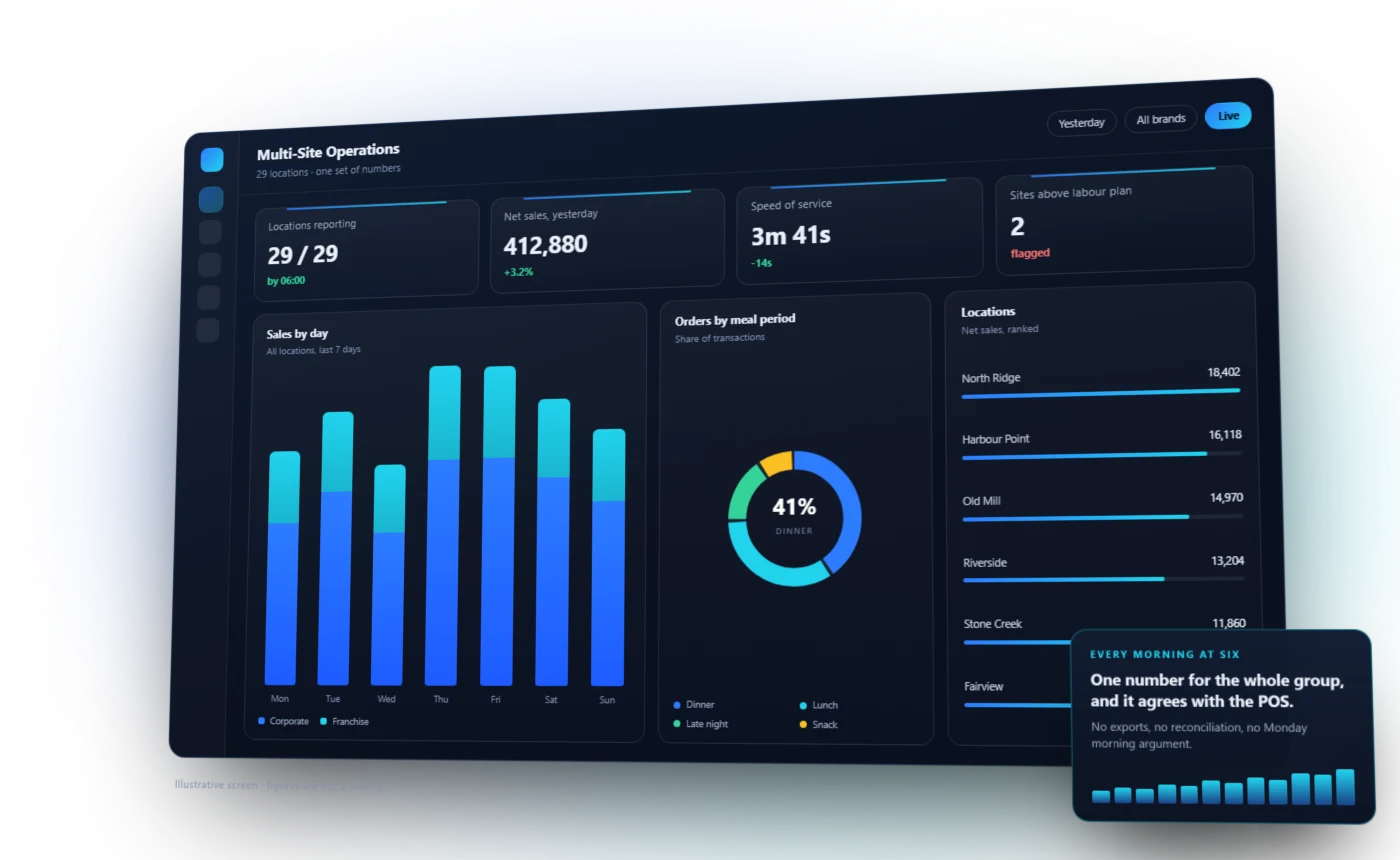
One dependable daily picture per location, current enough to change a decision.
Automate the weekly rebuild
Tip allocation, payroll exports and reconciliation, done the same way every period without a spreadsheet.
Carry you through a platform change
When the POS moves, the reporting and integrations move with it rather than being rediscovered afterwards.
Some problems deserve their own operating model.
- Tip pooling and payrollImplement the restaurant group's approved allocation rules, make each period reviewable, and produce the payroll output without rebuilding the logic in a spreadsheet.Explore tip pooling
- POS migration continuityRebuild the reporting and integrations the operation depends on before the legacy platform is removed, with totals reconciled against both sides.Explore reporting
- Delivery and ordering dataBring direct and marketplace orders, adjustments, fees and fulfillment events into the same operating picture as in-store sales.Explore integrations
Groups we have done this for.
Café Zupas
Rebuilt the reporting the group needed to complete its point-of-sale transition.
Casa Do Brasil
Replicated a tip-allocation model when the tool it depended on was discontinued, and made payroll nearly instant.
Take the Restaurant Reporting Scorecard.
Six questions about how your group runs today. You get a directional read on where reporting and manual work are most likely costing you, emailed to you as a copy. It is a starting point, not an audit.
What is the week costing you that it should not?
Tell us what your team rebuilds every period. That is usually where we start.