Software built around how your business actually works.
When an off-the-shelf product forces the business to work around it, those workarounds become the real system and the real cost. Since 2006, Suntek has built and supported software around the operation itself. We first test whether configuring or integrating what you have is the better answer. When custom is justified, one accountable team takes it from workflow and architecture through launch and ongoing support.
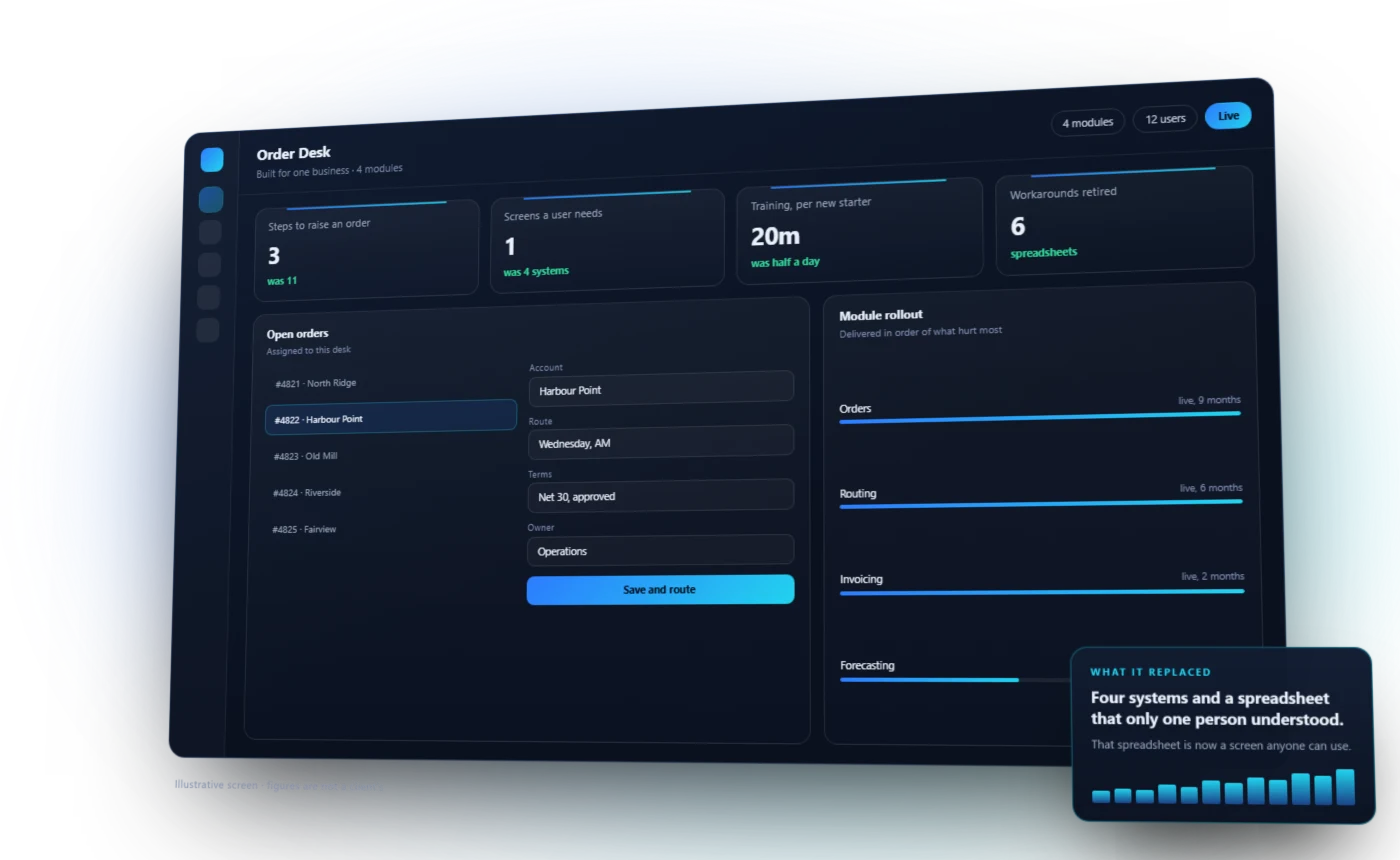
- The problem
- The software does not fit. Your team compensates with spreadsheets, duplicate entry and rules that live outside the product.
- What changes
- People work in one dependable system shaped around the operation, with fewer side processes and a clear place for the business rules.
- How Suntek works
- We make the build-or-buy decision with you, deliver in working pieces, connect the surrounding systems and remain accountable after launch.
Trusted by names you know




Clients and systems include Five Guys, Yoshinoya, Café Zupas, Casa Do Brasil, Arby's, Carvertise, Tosoh Quartz, Delivered Dish, Units Storage, PAR Technology, Brink POS.
This is usually the right call when
- You are paying for a platform your team uses a fraction of.
- Spreadsheets exist purely to make the real software usable.
- A tool you depend on was discontinued, sold or priced out of reach.
- Your process is genuinely specific to your business and no product matches it.
A complete operating system, not an isolated screen.
The visible application is only one part of dependable business software. We design the workflow, data, connections, permissions and operating model together so the result can carry real work after launch.
The application
- Business web applications
- Purpose-built tools for the workflows, roles and decisions that make your operation distinct.
- Customer and partner portals
- Secure, branded experiences for the people outside your organization who still need to work with it.
- iOS and Android
- Full mobile experiences for work that happens away from a desk, including notifications and location-aware workflows when appropriate.
- White-label platforms
- A shared foundation that can support different brands, customers, locations or franchisees without becoming separate products to maintain.
The operating workflow
- Roles and permissions
- Access shaped around companies, departments, teams and responsibilities rather than one universal login.
- Forms and approvals
- Structured intake, review and handoffs that replace email chains and spreadsheet trackers.
- Tasks and communication
- Work assigned from the same system that holds the context, attachments and status behind it.
- Reporting and alerts
- Operational views, scheduled delivery and notifications when a measure or process needs attention.
The systems around it
- APIs and integrations
- Connect the new application to the accounting, payroll, CRM, point of sale and vendor systems already in place.
- Data consolidation
- Bring fragmented sources into a consistent model without asking people to reconcile them by hand.
- Legacy modernization
- Replace vulnerable components in stages while preserving the business rules and history they still carry.
- Migration
- Move data and active workflows with reconciliation, validation and a path back if something does not agree.
The foundation
- Cloud infrastructure
- AWS or Azure environments designed around the application, its data and the way it must be operated.
- Security and data protection
- Authentication, access boundaries, encryption and data handling considered as part of the design rather than a final checklist.
- Scale and resilience
- Architecture chosen for the real load, failure modes and growth path instead of for a generic reference diagram.
- Support after launch
- The team that knows the decisions behind the software remains available to monitor, maintain and extend it.
Four reasons a business stops settling for off the shelf.
Custom software is justified by the operating advantage it creates or protects, not by the fact that it can be built.
Replace a discontinued dependency
Preserve the rules and workflow the business relies on when a vendor removes, sells or retires the product underneath it.
Unify a patchwork operation
Give teams one place to manage work that currently crosses separate portals, databases, files and manual handoffs.
Launch a branded experience
Build a customer, franchisee or partner journey around your business model rather than a software vendor's assumptions.
Modernize without starting over
Move a legacy system forward in working pieces while protecting its data, integrations and day-to-day operation.
Built to meet what you already run.
A custom application should reduce fragmentation, not become one more disconnected tool.
- Accounting
- Payroll
- CRM
- Point of sale
- Inventory
- Scheduling
- Delivery platforms
- Legacy databases
- Identity providers
- Document storage
- Email and messaging
- Any documented API
How the work runs
Decide first
We look at the actual workflow before proposing anything. Sometimes the honest answer is to configure what you already own, and we will say so.
Build in working pieces
You see something usable early and often, so the direction can change while changing it is still cheap.
Stay afterwards
The team that built it supports it. Software you depend on should not come with an ownership gap.
Wondering whether to build or buy?
Tell us what the software has to do. We will give you a straight recommendation, including when the answer is not to build.